Flooring Trends 2026: What's Changing This Year
Flooring styles move slower than fashion, but they do move. The looks that felt fresh a few years ago are giving way to warmer colors, wider planks, and floors built to shrug off water. If you are planning a project this year, it helps to know where things are headed before you shop.
Cool grays are fading. Narrow planks are shrinking from the conversation. Flooring that cannot handle moisture is a harder sell every season. Below are ten flooring trends for 2026 worth understanding, with honest notes on what each one is good for.
Warm Tones Take Over
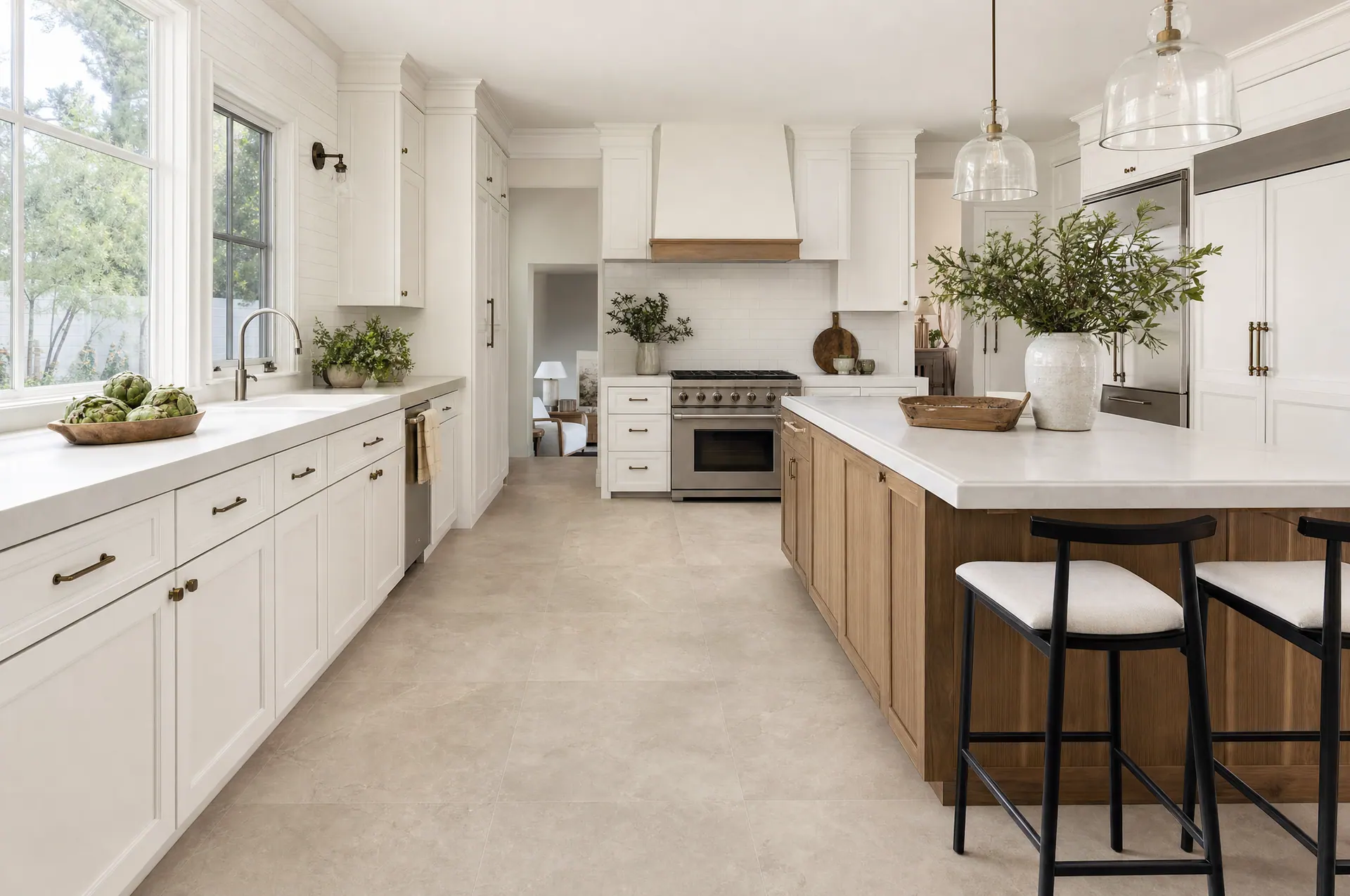
Warm-toned flooring is the biggest visual shift this year. After a long run of cool grays in showrooms and on design boards, homeowners and designers have moved toward honey oaks, warm walnuts, caramel maples, and sandy beiges across carpet, tile, hardwood, and vinyl.
Why Gray Lost Its Grip
Gray had a good run, but it shows every dust particle and photographs cold. Warm does not mean orange. Think muted golds, soft taupes, and natural wood tones with amber undertones. These colors pair with both modern and traditional furniture, hide everyday dirt better, and feel cozier underfoot than cool tones ever did.
Wide Plank Formats Go Even Wider
Wide-format planks, roughly 7 inches and up, are increasingly popular in both hardwood and luxury vinyl. Fewer seam lines create a cleaner, more open look. Rooms feel larger, and the floor reads as a surface rather than a pattern of strips.
The Subfloor Factor
Wider planks demand a flatter subfloor. Any dips or humps become more visible across a broad plank, so flatness matters more than it does with narrow boards. This is one of the details that separates a professional install from a DIY job that develops gaps by spring. If you are considering wide planks, get a free estimate and we will assess your subfloor first.
Want to see these looks in person? Call Carroll's Carpet & Flooring at (330) 666-7273 or visit us at 2381 Locust St., Canal Fulton, OH 44614. We can bring samples to your home or business in Canal Fulton and the surrounding area.
SPC Vinyl Becomes the Default Floor
Stone polymer composite (SPC) flooring has moved past "trending" into a baseline expectation for moisture-prone areas, and increasingly for whole homes. Waterproof performance is no longer a bonus feature. For many buyers it is the starting point.
SPC vs. WPC: What's the Difference
Both are rigid-core luxury vinyl, but the cores differ:
| Feature | SPC | WPC |
|---|---|---|
| Core material | Stone polymer (rigid) | Wood polymer (foamed) |
| Relative thickness | Thinner | Thicker |
| Dent resistance | Superior | Good |
| Underfoot comfort | Firmer | Softer |
| Sound absorption | Moderate | Better |
| Best for | High traffic, commercial | Bedrooms, living rooms |
For commercial vinyl flooring in restaurants, medical offices, and retail, SPC is often the better fit. It handles rolling loads from carts and chairs and stays dimensionally stable through Ohio's temperature swings.
Full-Home SPC Installs Are Common Now
Running one waterproof floor through an entire home, including kitchen, bathrooms, and laundry, has become a common request. It removes transitions between rooms and takes the worry out of splashes. For below-grade spaces, SPC's moisture and temperature resistance makes it a strong choice over hardwood or laminate. See our residential vinyl options for current product lines.
Matte and Textured Finishes Replace High Gloss
Matte finishes are an upgrade many homeowners overlook. A matte or low-sheen surface on hardwood or vinyl plank looks more natural, hides micro-scratches, and does not broadcast every footprint the way gloss does.
Three Textures Defining 2026
- Wire-brushed: A subtle linear texture that adds depth and disguises wear. Popular in both hardwood and LVP.
- Hand-scraped: A more dramatic, artisan look that suits farmhouse and rustic settings.
- Embossed-in-register (EIR): The most realistic texture on luxury vinyl. The tactile surface aligns with the printed grain, so it reads and feels like real wood.
Why Matte Wears Better
High-gloss floors look incredible on day one. Over time, without constant maintenance, they tend to look tired and scratched. Matte and textured surfaces show less dust and pet hair and offer more slip resistance. When minor scratches happen, and they always do, the texture helps camouflage them.
Biophilic Design Reaches the Floor
Biophilic design, bringing natural elements into built spaces, is showing up in flooring choices for both homes and commercial projects. It is not just picking a "wood look." It is capturing the organic variation, imperfection, and texture of real natural materials.
EIR textures play a big role here. When the printed grain aligns with a tactile surface you can feel underfoot, complete with knot details and plank-to-plank color variation, the result reads as genuinely natural. Biophilic flooring works best alongside other natural elements such as plants, daylight, wood furniture, and stone accents. If you are designing a commercial space from scratch, we can help you think through how the floor anchors the whole environment.
Carpet Tile Gets Creative in Commercial Spaces
Modular carpet tile is in the middle of a creative run in commercial carpet applications. Today's carpet tile ships in planks, hexagons, and custom shapes, so designers can build genuinely interesting layouts that serve both function and looks.
Zoning Without Walls
Mixing patterns lets a floor do the wayfinding in an open plan: a linear pattern in collaboration areas, a solid texture in focus zones, a bold geometric at the entry. Carpet tile also supports brand expression through color and real acoustic control, since carpet absorbs sound far better than hard surfaces. That matters in open offices.
The Replacement Advantage
If one tile stains or wears out, you replace that single tile instead of the whole floor. It is smart to keep 5 to 10 percent extra on hand as attic stock so future swaps match. That is something you simply cannot do with broadloom.
Large-Format Tile Replaces the 12x12 Grid
Oversized porcelain and ceramic tiles, such as 24x24 and 24x48, are replacing the standard 12x12 format that ruled kitchens and bathrooms for years. The effect mirrors wide-plank wood: fewer grout lines, cleaner sightlines, and a more modern presence.
Professional Installation Matters
Large-format tile is heavier and less forgiving than smaller formats. It needs a flat subfloor, near-full adhesive coverage, and specialized cutting tools. This is a project where professional installation pays off. Request a free estimate and we will walk through the details.
Sustainability Moves Up the Priority List
Sustainability in flooring has moved from a nice-to-have toward a baseline requirement, especially among commercial flooring buyers. Schools, healthcare facilities, and corporate offices increasingly ask about indoor air quality and environmental certifications early in the process.
Two certifications come up often: FloorScore and GreenGuard Gold. FloorScore certifies that products meet indoor air quality standards. GreenGuard Gold tests for a broad list of chemical emissions at thresholds strict enough for schools and hospitals. On the carpet side, recycled-content fibers let buyers make responsible choices without giving up softness.
PVC-Free Options
PVC-free flooring is a common question. Traditional vinyl contains PVC, which concerns some buyers, particularly in schools and healthcare. Newer products use alternative polymers that deliver comparable performance, so you are not trading durability for a greener product the way you once might have. If your commercial project needs LEED points or specific environmental benchmarks, reach out to our team.
Mixed-Material Layouts
Combining different flooring materials within a single space is increasingly popular: hardwood in the living room flowing into tile in the kitchen, or SPC vinyl through the main floor with carpet in the bedrooms.
The key is intentional transitions: flush T-moldings in matching tones and threshold strips that complement rather than interrupt. This approach lets you match each room to its real demands, with water resistance where you need it and warmth underfoot where you want it.
Color-Matched Stair Nosings and Transitions
This is a small detail that makes a big difference. Color-matched stair nosings, flush reducers, and T-moldings mean your transitions look intentional rather than like an afterthought. Carrying the exact color and texture of a main floor up a staircase with matching stair nosings creates a continuous, finished look. Most quality product lines offer matching trim pieces, so there is no reason to settle for generic oak nosings on a warm walnut floor.
Seeing these looks in person changes everything. Samples on a screen do not capture texture, color depth, or scale. Call Carroll's Carpet & Flooring at (330) 666-7273 or stop by 2381 Locust St., Canal Fulton, OH 44614. We serve Canal Fulton and the surrounding area.
Frequently Asked Questions
What is the most popular flooring trend for 2026?
Warm-toned flooring is the dominant shift across residential and commercial projects. Honey oaks, warm walnuts, and natural amber tones are replacing cool grays across vinyl plank, hardwood, carpet, and tile.
Is SPC waterproof flooring worth it?
For most Ohio homes, it is a sensible choice. Between basement moisture, kitchen spills, and bathroom humidity, a waterproof core removes a whole category of worry, and the look has caught up to real wood.
Which flooring trends matter most for commercial spaces?
Three stand out: SPC vinyl plank for high-traffic lobbies and hallways, creative carpet tile for offices and collaborative zones, and large-format porcelain tile for entries and dining areas. Indoor air quality certifications like FloorScore and GreenGuard Gold also come up more often on commercial bids, and acoustic performance drives many office decisions.
How do I choose between hardwood and luxury vinyl plank?
Real hardwood offers unmatched warmth and can be refinished multiple times. Luxury vinyl plank is waterproof, generally more affordable, and, with EIR textures, looks very close to wood. For moisture-prone areas or tighter budgets, LVP usually wins. For formal living spaces where you want the real thing, hardwood is hard to beat.
Are sustainable flooring options as durable as traditional products?
Generally yes. Products carrying FloorScore and GreenGuard Gold certifications meet performance standards comparable to conventional flooring, so you are not trading durability for responsibility.
What flooring works best in Ohio basements?
SPC vinyl plank is a strong choice below grade. Basements deal with moisture and temperature swings that are hard on hardwood and laminate. SPC resists warping and will not grow mold, and it installs over concrete with a moisture barrier.
What affects the cost of a new floor?
Several things, not just the price of the material: the grade of product you choose, room size and layout, subfloor condition and prep, removal of the old floor, install complexity, and the number of stairs and transitions. For a firm number on your project, request a free estimate.
Should I follow trends or choose something timeless?
The strongest current trends, warm tones, matte finishes, and wide planks, are really returns to classic looks rather than fads. Warm wood tones and natural, low-sheen finishes have been popular for a long time, so these are not choices most people regret in a few years.
Let's Talk About Your Floors
These ten trends are not just magazine talk. They are the looks people are asking about and installing in homes and businesses right now. Whether you want warm-toned wide planks, a creative carpet tile layout, a full-home SPC install, or large-format tile, we can help you sort through the options.
Carroll's Carpet & Flooring has helped customers make smart flooring choices since 1946. Call us at (330) 666-7273, stop by 2381 Locust St., Canal Fulton, OH 44614, or request your free estimate online and we will bring samples to you. We serve Canal Fulton and the surrounding area.
Check out our gallery to see projects, or learn more about our story.