Flooring Is Part of a Healthcare Facility's Infection Control
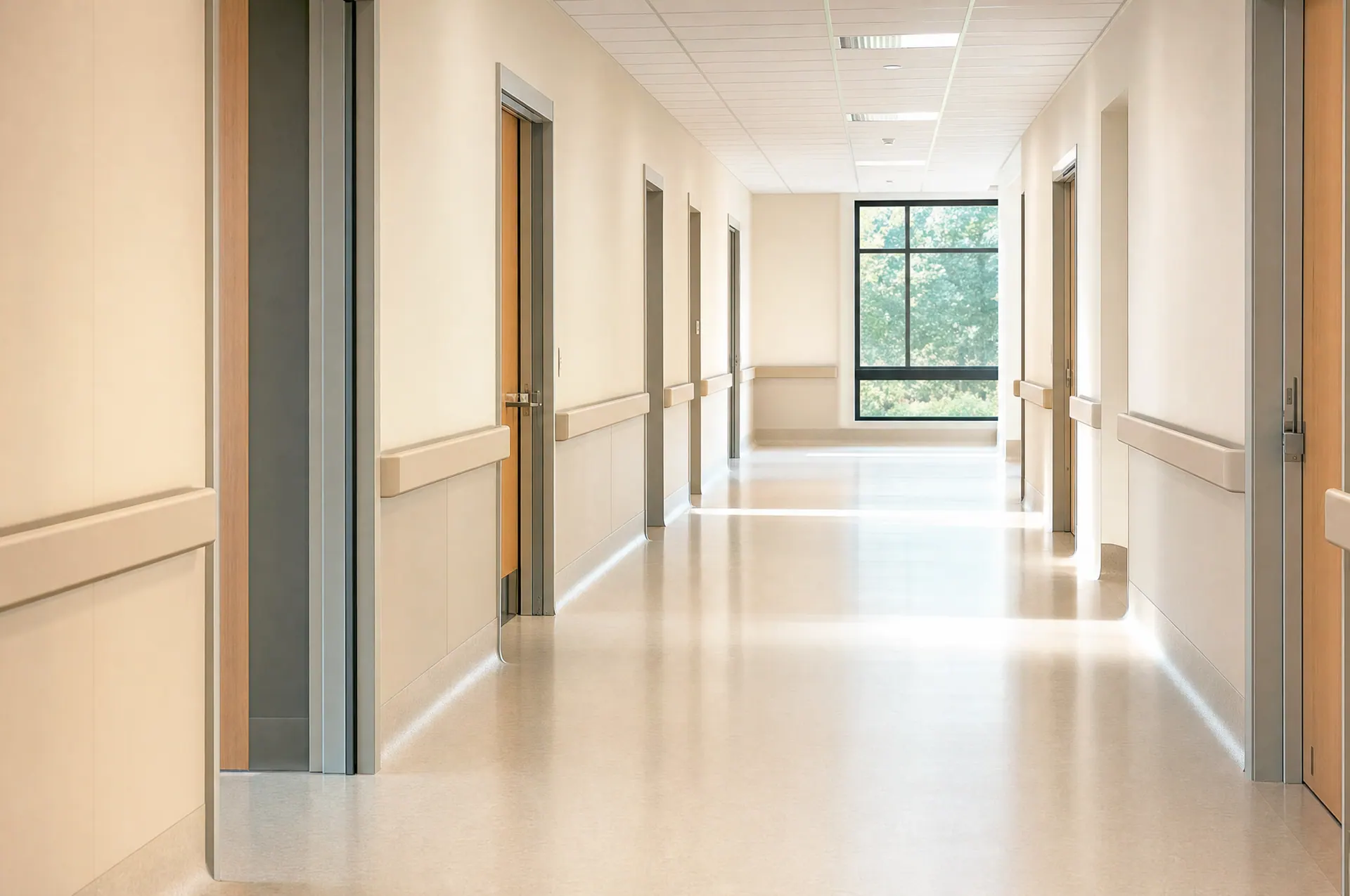
In a medical setting, the floor is more than a finish. Smooth, intact, cleanable flooring helps limit the places where bacteria can collect, while a cracked seam, a failed grout line, or lifting adhesive can create a gap that is hard to clean and easy to overlook. Contaminated environmental surfaces, floors included, can contribute to the spread of pathogens, so the condition and construction of a floor matter in patient care areas.
At Carroll's Carpet and Flooring, we have been selling and installing flooring since 1946 from our location in Canal Fulton, Ohio. We work with both residential and commercial customers, and commercial flooring is a core part of what we do. This article covers what to think about before choosing flooring for a healthcare space, from the standards that apply to how the major product types compare.
Why Healthcare Flooring Differs from Standard Commercial
Flooring in a medical environment has to satisfy clinical, regulatory, and operational demands that a typical commercial space never faces. A retail floor needs to look good and handle foot traffic. An exam room floor needs to survive daily chemical disinfection, wheelchair and rolling-bed loads, and biological spills, all while staying slip resistant and supporting infection prevention.
That gap between "commercial" and "healthcare-grade commercial" catches a lot of facility managers off guard. Standard commercial flooring that holds up fine in an office can degrade faster in a clinic, where aggressive disinfectants attack the wear layer and heavy, repetitive traffic stresses every seam. Product selection and installation quality carry more weight in healthcare than in almost any other setting.
Regulatory and Compliance Considerations
Healthcare flooring generally has to work within a layered set of accessibility, safety, and infection control expectations. Here are the ones that most often shape a specification.
ADA Accessibility
The Americans with Disabilities Act calls for accessible flooring throughout healthcare facilities. In practical terms that means:
- No abrupt vertical transitions between flooring materials at doorways and thresholds
- Firm, stable, slip-resistant surfaces in patient-accessible areas
- Materials that do not add rolling resistance for wheelchairs
- Color or contrast cues at transitions to help people with low vision
Transitions are a common trouble spot, especially in older offices where carpet meets tile or a past renovation left a height mismatch. Those spots are both an accessibility concern and a trip hazard.
Slip Resistance (ASTM D2047)
ASTM D2047 is the standard test for the static coefficient of friction (COF) of a walkway surface, and 0.5 is the commonly cited minimum. In healthcare, wet corridors, spilled fluids, and freshly mopped rooms are routine, so a floor needs to perform in those conditions, not just when dry. Rubber flooring tends to test very well for slip resistance. Because COF varies from product to product and finish to finish, it is worth verifying the rating for the specific product being considered.
Infection Control and Survey Readiness
Infection control guidance generally favors smooth, nonporous flooring in patient care areas, and accreditation surveyors look at flooring condition: floors should be intact, cleanable, and free of damage that could harbor bacteria. Two construction details help a great deal here. Heat-welded seams in homogeneous sheet vinyl close the microgaps where pathogens can collect. Flash coving, where the flooring curves up the wall a few inches, removes the floor-wall joint entirely. Together they create a sealed, continuous surface well suited to sterile environments.
Acoustics
Sound transfer matters in exam rooms, consultation areas, and offices where private health information is discussed. Cushion-backed vinyl and rubber flooring dampen sound better than hard tile or bare concrete, which is worth weighing where acoustic privacy and a calmer environment are priorities.
Chemical and Disinfectant Resistance
Healthcare spaces are cleaned with disinfectants strong enough to kill resilient pathogens, sometimes several times a day. Flooring has to withstand that repeated chemical exposure without staining, softening, discoloring, or losing wear-layer integrity. Not every commercial product is rated for it, so chemical resistance should be confirmed before a product is specified for medical use.
Not sure which standards apply to your space? Request a free estimate or call (330) 666-7273. We will look at your facility and recommend products suited to how each room is used.
Healthcare Flooring Types Compared
Not every commercial flooring product performs the same way in a medical environment. Here is how the major categories generally stack up for healthcare use.
Homogeneous Sheet Vinyl, the Clinical Standard
Homogeneous sheet vinyl is a single-layer product with uniform composition through its full thickness. Healthcare-oriented lines often add antimicrobial treatment and enhanced chemical resistance, and many carry indoor-air-quality certification.
Sheet vinyl is the usual choice where infection control is the top priority. Heat-welded seams create a watertight, continuous surface, flash coving seals the floor-wall transition, and the material stands up to aggressive disinfectants. It is not the least expensive option, but in sterile spaces its performance is hard to match.
Strengths:
- Heat-welded seams for zero-gap infection control
- Flash coving for sealed floor-wall transitions
- High chemical resistance
- Low-VOC and air-quality-certified options
- Antimicrobial treatment common on healthcare lines
Best for: Operating rooms, procedure suites, sterile processing, laboratories, pharmacies.
Heterogeneous LVT, Performance and Aesthetics
Heterogeneous luxury vinyl tile uses several layers: a wear layer, a printed design layer, a core, and a backing. Modern commercial LVT performs like medical-grade flooring but can look like wood plank, stone, or designer tile, which helps a space feel less institutional.
Strengths:
- Wide design range for a welcoming patient environment
- Durable, especially with a thicker wear layer
- Good chemical resistance (verify disinfectant compatibility for the specific product)
- Easier section replacement than sheet vinyl
- Typically lower installed cost than homogeneous sheet
Best for: Patient rooms, exam rooms, waiting areas, corridors, administrative offices.
Rubber Flooring, Comfort and Safety
Rubber flooring offers excellent slip resistance wet or dry, and it cushions underfoot, which matters for staff who spend long shifts on their feet. Its acoustic properties are strong as well, helping reduce the ambient noise that can add to patient stress.
Strengths:
- High slip resistance, wet and dry
- Cushioning that reduces staff fatigue
- Good acoustic performance
- Durable under heavy wheeled traffic
- No waxing or finish coats required
Best for: Corridors, nurse stations, physical therapy areas, cafeterias, entryways.
Commercial Carpet Tile, Waiting and Admin Areas
Carpet does not belong in patient care areas. In waiting rooms, offices, and conference rooms, though, commercial carpet tile adds warmth and acoustic comfort that hard surfaces cannot. Solution-dyed nylon resists staining, and modular tiles let you replace a damaged section instead of a whole room.
Strengths:
- Good acoustic absorption
- Warm and comfortable in seating areas
- Modular design for targeted replacement
- Antimicrobial backing options
- A welcoming first impression in lobbies
Best for: Waiting rooms, lobbies, administrative offices, break rooms, conference rooms.
Porcelain and Ceramic Tile, Situational Use
Commercial tile works well in restrooms, dietary kitchens, and some entry areas. In patient care spaces, though, grout lines, even epoxy grout, are a weaker point for infection control than sheet vinyl or LVT, which is why seamless or tight-seam options have largely taken over clinical areas.
Best for: Restrooms, dietary kitchens, building entryways.
Side-by-Side Comparison
| Feature | Sheet Vinyl | Commercial LVT | Rubber | Carpet Tile | Porcelain Tile |
|---|---|---|---|---|---|
| Infection Control | Excellent | Good | Good | Poor | Moderate |
| Slip Resistance (COF) | High | High | Highest | N/A | Moderate–High |
| Chemical Resistance | Excellent | Good–Excellent | Excellent | Poor | Excellent |
| Acoustic Performance | Moderate | Low–Moderate | Excellent | Excellent | Poor |
| Staff Comfort | Moderate | Low–Moderate | Excellent | High | Poor |
| Aesthetics Range | Limited | Excellent | Moderate | Good | Excellent |
| Maintenance Burden | Low | Low–Moderate | Very Low | Moderate–High | Low–Moderate |
Room-by-Room Guidance
Different spaces in a healthcare facility have different demands. Here is a general starting point for each.
Operating Rooms and Procedure Suites
Typical choice: Homogeneous sheet vinyl with heat-welded seams and flash coving.
These rooms demand the highest infection control. Sheet vinyl with heat-welded seams, coved up the wall, creates a sealed basin so spills and cleaning solutions stay on the surface with nothing migrating underneath. Static-dissipative formulations are available for rooms with flammable anesthetic gases, though most modern surgical suites do not need them.
Patient Rooms and Exam Rooms
Typical choice: Heterogeneous LVT with a thicker wear layer, or sheet vinyl for higher-acuity rooms.
Patient rooms need infection control, durability, a comfortable look, and the ability to take daily chemical cleaning. LVT fits well here because it looks residential while handling the demands of a clinical space. A thicker wear layer holds up better under bed movement, wheelchair traffic, and frequent disinfection. For higher-acuity rooms, sheet vinyl adds extra seam integrity.
Corridors and High-Traffic Zones
Typical choice: Rubber flooring or a heavy-duty commercial LVT.
Corridors absorb more abuse than anywhere else: gurneys, wheelchairs, med carts, and housekeeping equipment all day. Rubber handles that load while cushioning staff. Where aesthetics lead, a heavy-duty LVT with a thick wear layer is a strong alternative.
Waiting Areas and Lobbies
Typical choice: Commercial LVT or carpet tile, depending on the feel you want.
The waiting room sets the tone for a visit. A wood-look commercial LVT reads warm and modern, while carpet tile adds softness and quiet in seating clusters. Many facilities use both: hard surface in walkways, carpet tile under seating.
Laboratories and Pharmacies
Typical choice: Homogeneous sheet vinyl with verified chemical resistance.
Labs deal with chemical spills that would ruin most products. Sheet vinyl with heat-welded seams and confirmed chemical resistance is the appropriate choice, and flash coving closes off any floor-wall gap that could become a contamination path. Chemical resistance should be checked against the specific reagents and solvents a given lab uses.
Restrooms
Typical choice: Sheet vinyl (preferred) or porcelain tile with epoxy grout.
Both work. Sheet vinyl removes grout entirely and is easy to maintain. Porcelain tile with epoxy grout handles moisture well and provides good slip resistance. Single-occupant clinic restrooms often use sheet vinyl, while larger multi-stall restrooms frequently use tile.
Planning a healthcare flooring project? We will visit, walk every room, and put together a room-by-room plan. Get your free estimate or call (330) 666-7273.
Installation in Active Medical Facilities
Product selection is only half the job. In healthcare, "installed correctly" also means protocols that many general contractors do not think about. A good product installed poorly can create infection control problems, premature wear, and safety hazards.
Phased Scheduling to Minimize Disruption
Most healthcare facilities cannot shut down. Phased scheduling, working area by area so patient flow continues, keeps a practice open during the work. Larger projects can be broken into stages with temporary wayfinding and clear communication with the operations team at each step.
Infection Prevention During Construction
During installation, dust, adhesive fumes, and debris become infection control concerns. Common precautions include:
- Sealed containment barriers between work zones and active patient areas
- Negative air pressure in zones next to patient care
- HEPA filtration for dust-generating work like demolition and grinding
- After-hours scheduling for the most disruptive phases
- Cleaning and air-quality checks before an area returns to service
In an accredited facility these are expectations, not extras.
Subfloor Preparation
Healthcare flooring failures often trace back to the subfloor. Moisture in a concrete slab can cause adhesive failure, sometimes releasing whole sections. Uneven surfaces create bumps and trip hazards, and leftover adhesive from old flooring prevents a proper bond. Moisture testing the slab before installation, and adding a moisture mitigation system when readings are too high, prevents the kind of failure that forces an emergency replacement later.
Adhesives and Indoor Air Quality
Low-VOC and zero-VOC adhesives are the sensible default in a medical space, where patients with respiratory conditions, weakened immune systems, or chemical sensitivities are especially vulnerable to volatile organic compounds. Proper ventilation and adequate curing time before an area returns to patient use matter just as much as the adhesive choice.
What Affects Your Cost
Rather than a single price per square foot, think about the factors that shape a healthcare flooring budget:
- Material grade — Homogeneous sheet vinyl, rubber, heavy-duty LVT, and carpet tile sit at different price points, and healthcare-rated lines cost more than basic commercial goods.
- Room size and layout — Columns, curved walls, many doorway transitions, and irregular rooms all add labor.
- Subfloor prep — Moisture mitigation, leveling, and old adhesive removal add to the scope.
- Removal of old flooring — Taking out glued-down VCT or sheet vinyl adds labor and disposal.
- Installation complexity — Heat-welded seams, flash coving, phased after-hours scheduling, and infection-control containment all affect the total.
It is also worth thinking in terms of lifecycle rather than first cost. A product that is cheap to install but needs frequent stripping, waxing, and closures can cost more over its life than a product with a higher installed price and low maintenance. We are glad to walk through these trade-offs for your specific space. Request a free estimate for a plan built around how your rooms are actually used.
Maintenance by Flooring Type
Good maintenance extends floor life, preserves infection control performance, and keeps a facility survey-ready.
Sheet Vinyl and LVT
- Daily: Dust mop or auto-scrub with a neutral pH cleaner, and address spills right away.
- Weekly: Damp mop with a manufacturer-approved disinfectant.
- Monthly: Machine scrub with a non-abrasive pad, which matters for urethane-finished surfaces.
- Annually: Recoat with the recommended finish if applicable, and inspect seams for separation.
Avoid bleach-based cleaners unless the manufacturer approves them, since some disinfectants can degrade urethane wear layers over time.
Rubber Flooring
- Daily: Dust mop and damp mop with a neutral cleaner.
- Weekly: Auto-scrub with a manufacturer-approved solution.
- Quarterly: Deep scrub with an alkaline cleaner to remove buildup.
- As needed: No waxing or finish coats, which means no refinishing downtime.
Commercial Carpet Tile
- Daily: Vacuum with a CRI-approved vacuum, with HEPA filtration strongly recommended in healthcare.
- Weekly: Spot-treat stains with an approved spotter.
- Quarterly: Hot water extraction.
- As needed: Replace individual tiles that are permanently stained, damaged, or worn, instead of redoing a whole room.
Porcelain Tile
- Daily: Sweep or dust mop, then damp mop with a neutral cleaner.
- Weekly: Scrub grout lines with an appropriate cleaner.
- Annually: Reseal grout if it is cement-based; epoxy grout does not require resealing.
Choosing a Healthcare Flooring Contractor
The contractor matters as much as the product. A few things to look for:
- Experience in active medical environments. Installing in an operating practice is very different from an empty retail space; phased scheduling, infection control, and after-hours work take planning.
- Familiarity with the applicable standards. A good installer should understand accessibility, slip resistance, and infection control expectations, not just how to lay a floor.
- Verified chemical resistance and proper installation details. Heat-welded seams, flash coving, and documented product suitability protect your facility.
- A local presence. Working with a nearby company makes questions and follow-up far easier after the job is done.
Frequently Asked Questions
What is the best flooring for a medical office?
For most medical offices, commercial LVT with a thicker wear layer offers a strong mix of performance, aesthetics, and value. It handles disinfectants, supports slip-resistance standards, and comes in designs that create a welcoming space. For surgical or sterile areas, homogeneous sheet vinyl with heat-welded seams remains the clinical standard.
How much does healthcare flooring cost?
Cost depends on material grade, room size and layout, subfloor prep, removal of any old flooring, and installation complexity such as heat-welded seams or phased after-hours work. The best way to get an accurate number is a free estimate based on your actual space. It is also worth comparing lifecycle cost, not just the installed price, since maintenance adds up over the years.
Can you install flooring in a clinic without shutting down?
Usually, yes. Phased installation with sealed containment barriers, HEPA filtration, and after-hours scheduling can keep a facility operating. It takes careful planning, which is built into the project before the work starts.
Does healthcare flooring need antimicrobial treatment?
It is not universally required by code, but it is commonly recommended for patient care areas. Antimicrobial properties help inhibit bacterial and fungal growth on the surface between cleanings, and many healthcare-specific product lines include the treatment as standard.
What flooring passes accreditation surveys?
No single product is mandated. Surveyors look for floors that are smooth, intact, cleanable, and free of damage that could harbor bacteria. Sheet vinyl and commercial LVT in good condition tend to do well. Damaged VCT, cracked grout, worn carpet in clinical areas, and separated seams are common findings.
Is VCT still appropriate for healthcare facilities?
VCT was the standard for decades, but many facilities are moving away from it. Its frequent strip-and-wax cycle is costly and disruptive, and it leaves the floor vulnerable between refinishing. Modern commercial LVT and sheet vinyl generally outperform VCT on chemical resistance, infection control, maintenance, and appearance.
How do I choose between sheet vinyl and LVT?
Use sheet vinyl where you need the highest infection control: operating rooms, procedure rooms, labs, and sterile processing, where heat-welded seams and flash coving create a sealed surface. Use LVT in patient rooms, exam rooms, waiting areas, and corridors, where you want more design options and a somewhat lower installed cost. Many facilities use both, and we can help you make that decision room by room.
Start Your Healthcare Flooring Project
Getting healthcare flooring right takes more than picking a sample from a board. It takes understanding the standards that apply, the daily realities of a medical operation, and the installation details that protect patients and staff during the work.
Carroll's Carpet and Flooring has been selling and installing commercial flooring since 1946, serving Canal Fulton and the surrounding area for both residential and commercial customers. If you are building, renovating, or replacing flooring in a healthcare space, we would be glad to help.
Call (330) 666-7273 or request your free estimate. We will visit your facility, look at every space, and put together a room-by-room plan.
Carroll's Carpet and Flooring, 2381 Locust St., Canal Fulton, OH 44614.