Why Commercial Vinyl Has Become So Popular
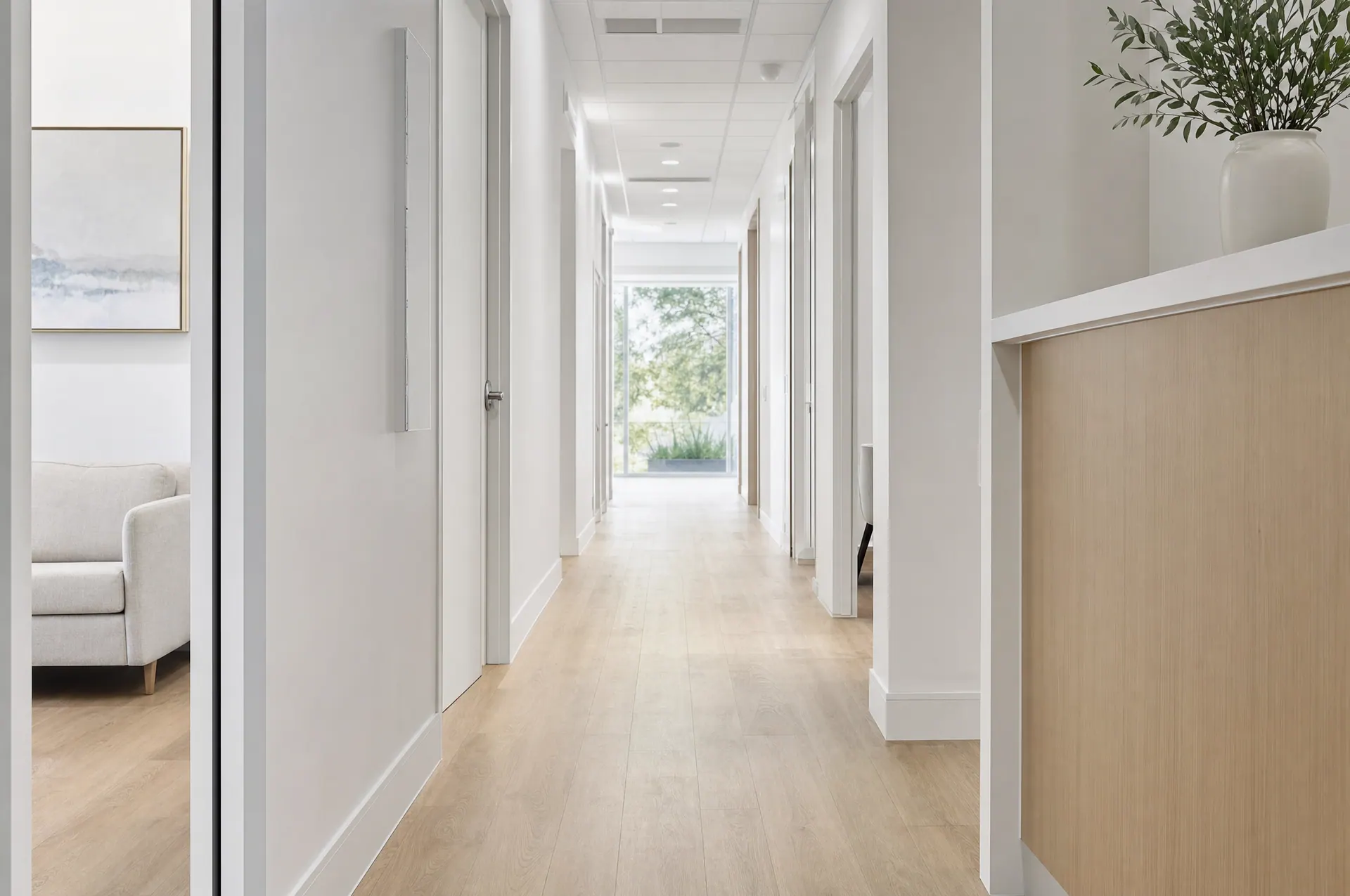
Commercial vinyl flooring has taken over a lot of spaces that used to go to VCT (vinyl composition tile) or commercial carpet. The reason is simple: modern vinyl offers waterproof performance, realistic looks, and low maintenance in one product. It has evolved from flimsy peel-and-stick squares into engineered systems that handle rolling loads and heavy foot traffic.
At Carroll's Carpet and Flooring in Canal Fulton, Ohio, we have been selling and installing flooring since 1946 for residential and commercial customers, and commercial vinyl is one of our most-requested products. This guide walks through the product types, core technology, wear layers, installation methods, and the factors that shape cost so you can make a confident decision.
LVT vs. LVP: Tile Format or Plank Format?
LVT (luxury vinyl tile) and LVP (luxury vinyl plank) share the same multi-layer construction. The real difference is shape and visual pattern. LVT comes in square or rectangular tiles that mimic stone, slate, or ceramic. LVP comes in long planks that replicate hardwood grain. Performance is the same, so this is largely an aesthetic choice.
LVT tends to suit healthcare environments and other spaces where a clean, tile-like look reinforces trust, and it unlocks pattern options like herringbone, checkerboard, and basketweave layouts. LVP tends to suit office projects, where a warm wood-grain plank updates a dated space without the maintenance of real hardwood.
Here is a quick format comparison:
| Feature | LVT (Tile) | LVP (Plank) |
|---|---|---|
| Typical size | 12" x 24" or 18" x 18" | 7" x 48" or 9" x 60" |
| Look | Stone, slate, ceramic | Hardwood grain |
| Best for | Healthcare, retail, lobbies | Offices, conference rooms, hospitality |
| Pattern options | Herringbone, checkerboard, stacked | Staggered, mixed-width |
| Installation | Click-lock, glue-down, loose-lay | Click-lock, glue-down, loose-lay |
Both formats handle commercial traffic the same way when you spec the right wear layer, so pick the look that fits your brand.
Want to compare LVT and LVP samples? Call (330) 666-7273 to set up a free site visit. We can bring samples to your location so you can see the options in your own lighting.
SPC vs. WPC: Choosing the Right Core
SPC (stone polymer composite) and WPC (wood polymer composite) are the two dominant core technologies in modern commercial vinyl. SPC uses a dense, rigid core of limestone powder and PVC. WPC uses a foamed, cushioned core that is softer underfoot but less rigid. For most commercial applications, SPC is the stronger choice.
SPC's density translates directly into dent resistance. Rolling office chairs, loaded hand trucks, pallet jacks, and carts are hard on a floor, and a rigid SPC core resists the point loads that can dent a softer WPC core. SPC is also more stable through temperature swings, which helps in spaces where the HVAC cycles aggressively or heating is inconsistent.
WPC still earns its place. Its cushioned core is easier on the legs where people stand for long stretches, such as reception areas and school administration offices, and it tends to dampen sound a bit better, which matters in libraries, counseling offices, and other quiet spaces.
| Property | SPC Core | WPC Core |
|---|---|---|
| Density | Higher | Lower |
| Dent resistance | Excellent | Moderate |
| Temp stability | Superior | Good |
| Comfort underfoot | Firm | Cushioned |
| Sound absorption | Moderate | Better |
| Waterproof | Yes | Yes |
| Best for | High traffic, rolling loads | Standing comfort, quiet spaces |
A good rule of thumb: if the space sees wheeled traffic of any kind, lean toward SPC.
Wear Layer Ratings: The Spec That Determines Lifespan
The wear layer is the clear top coating that protects vinyl against scratches, scuffs, stains, and UV fading. It is measured in mils (thousandths of an inch), and it is a big factor in how a floor looks years down the road. In general, thinner wear layers suit light use and thicker wear layers suit heavier commercial traffic:
- Thinner wear layers are really a light-commercial or residential spec, suitable at most for a private office or a low-traffic boutique.
- Mid-range wear layers are the entry point for genuine commercial use: professional offices, small retail, and conference rooms with moderate traffic.
- Thicker wear layers suit busy corridors, medical office hallways, busy retail, and restaurant dining rooms, where the performance-to-cost balance tends to land well.
- The heaviest wear layers are for heavy-duty commercial and light-industrial settings with constant foot and wheeled traffic.
Many premium products also add a UV-cured polyurethane or ceramic-bead top finish over the wear layer. These coatings resist scuffing and simplify maintenance: no waxing, stripping, or buffing, just sweeping and damp mopping with a neutral pH cleaner. That low-maintenance profile is a real operating-cost advantage over VCT, which needs regular strip-and-wax cycles.
Three Installation Methods Compared
The three main methods are click-lock (floating), glue-down (full spread), and loose-lay (friction grip). Each has trade-offs, and the right choice depends on subfloor condition, space size, and whether you will need access under the floor later.
Click-lock is usually the fastest. Planks or tiles snap together over an underlayment with no adhesive, which minimizes disruption. The trade-off is that click-lock can shift slightly in very large open areas without transitions, and it can telegraph subfloor imperfections more than glue-down.
Glue-down is the most solid option for demanding commercial spaces. Full-spread adhesive bonds every square inch to the subfloor, so the floor will not shift or sound hollow and it handles heavy rolling loads well. It takes longer and costs more in labor and adhesive, but for healthcare, retail, restaurants, and anywhere with carts or dollies, it is often worth it.
Loose-lay uses a heavy friction-grip backing with adhesive only at the perimeter. Individual pieces can be lifted and replaced without disturbing the rest, which is handy where there is underfloor data cabling to reach or in tenant spaces where the floor may need to come up at lease end.
Good installation is not optional. A poor install can void manufacturer warranties and create failures that have nothing to do with the product itself, so it is worth evaluating each project's subfloor and layout before choosing a method.
Weather and Commercial Vinyl Performance
A Northeast Ohio winter is hard on floors: tracked-in road salt, snowmelt pooling in entryways, and humidity that swings widely between seasons. Commercial vinyl handles these conditions well when the right product is specified.
SPC-core vinyl is waterproof, not just water resistant. The limestone-and-PVC core cannot absorb moisture, swell, or delaminate, which makes it a sound choice for restaurants, veterinary clinics, taprooms, and other spaces where liquid exposure is a daily reality.
Road salt is a quiet threat because salt crystals grind into a floor surface like sandpaper under boot traffic. A thicker wear layer, especially with a ceramic-bead finish, resists that abrasion much better than a thin one, so entryway zones are a good place to spec the highest wear layer the budget allows.
One installation note for spaces without consistent climate control, such as warehouses, garages, and seasonal retail: leaving slightly wider expansion gaps than the manufacturer minimum gives the floor room to move through temperature swings and helps prevent buckling.
Commercial vinyl with an antimicrobial surface treatment is also worth considering where salt-laden snowmelt tends to sit in seams or transitions, since tight glue-down seams plus an antimicrobial wear layer reduce the spots where bacteria can take hold.
Planning a commercial flooring project? Request a free estimate or call (330) 666-7273. We will assess your space and recommend the right product for your conditions.
Industry-Specific Recommendations
Different industries ask different things of their floors. Here are general recommendations by sector.
Healthcare and Medical
Healthcare facilities prioritize infection control and slip resistance. A common approach is glue-down LVT with heat-welded seams, which leave no gaps for bacteria, a thicker antimicrobial wear layer, and products that meet slip-resistance expectations (a static coefficient of friction at or above 0.5 per ASTM D2047). Accessibility compliance is essential for any patient-facing space, and chemical-resistant surfaces are needed to stand up to daily disinfection.
Education and Schools
Schools are hard on floors, from rolling AV carts to crowded hallways between periods. A thicker SPC with a scratch-resistant finish holds up well, and acoustic underlayments can make a noticeable difference in classroom noise. Indoor-air-quality certification matters here too, since students spend long days in the building.
Corporate Offices
Offices balance a professional look with practical performance. Wood-grain LVP in medium tones creates a warm atmosphere without hardwood's maintenance. Click-lock or loose-lay works where rolling loads are limited to desk chairs, though chair mats still help extend floor life. For large open-plan offices, glue-down helps prevent any floating-floor movement.
Retail and Hospitality
Retail spaces need visual impact that draws customers in, and mixing LVT and LVP in one project, stone-look tile in main aisles and wood-look plank in display zones, can do that. Restaurants and breweries need the same waterproof performance as healthcare but with a different aesthetic, and a thicker wear layer helps them stand up to spills and constant mopping.
Commercial Vinyl Certifications and Standards Worth Knowing
The flooring industry has many certifications. A few are genuinely useful when evaluating commercial vinyl:
FloorScore — Tests for VOC (volatile organic compound) emissions against a strict indoor-air-quality benchmark. Where people spend extended time, FloorScore-certified products are worth specifying.
ASTM D2047 — The standard test for static coefficient of friction. A floor in a public-facing space should meet the 0.5-or-higher threshold for slip resistance.
ASTM F1700 and F2199 — F1700 covers the specification for solid vinyl floor tile, and F2199 addresses dimensional stability. These help confirm a product performs as advertised.
Accessibility compliance — Public-facing spaces need to meet slip-resistance and transition-height requirements, including ramped transitions at elevation changes and threshold strips at doorways.
Proper installation — Manufacturer warranties generally depend on correct installation to published guidelines, so following the manufacturer's method is what protects both the warranty and the investment.
Vinyl vs. VCT vs. Carpet vs. Tile: Quick Comparison
This comparison shows how commercial vinyl generally stacks up against other common options.
| Factor | Commercial Vinyl (LVT/LVP) | VCT | Commercial Carpet Tile | Ceramic/Porcelain Tile |
|---|---|---|---|---|
| Lifespan | Long | Moderate | Moderate | Longest |
| Maintenance | Sweep + damp mop | Strip & wax regularly | Vacuum + extract | Grout cleaning + sealing |
| Waterproof | Yes (SPC) | No | No | Yes (not grout) |
| Comfort | Moderate (SPC) / Good (WPC) | Hard | Soft | Hard |
| Install speed | Fast | Moderate | Fast | Slow |
| Design options | Extensive | Limited | Moderate | Extensive |
Commercial vinyl tends to win on total cost of ownership in many scenarios. VCT is cheaper upfront but costs more to maintain because of its strip-and-wax cycle. Carpet tile excels at acoustics and comfort but cannot handle moisture. Ceramic tile lasts longest but costs more to install and maintain.
What Affects Your Cost
Rather than quoting a single number, here are the factors that shape a commercial vinyl budget:
- Material grade — A mid-range click-lock SPC sits at the entry level, while a thick glue-down product with an antimicrobial treatment and heat-welded seams sits at the top.
- Room size and layout — Columns, curved walls, multiple doorway transitions, and irregular layouts all add labor hours.
- Subfloor prep — Uneven concrete, old adhesive removal, moisture remediation, or self-leveling compound add to the scope.
- Removal of old flooring — Taking out existing flooring, especially glued-down VCT or sheet vinyl, adds labor and disposal.
- Installation complexity — Heat-welded seams, intricate patterns, and after-hours or weekend scheduling to avoid business disruption all affect the total.
It also pays to think in lifecycle terms. A well-installed vinyl floor needs little more than sweeping and damp mopping, while VCT needs repeated strip-and-wax cycles that add up over the years. We provide detailed, line-by-line estimates with no hidden fees. Request a free estimate and we will walk through every cost with you before you commit to anything.
FAQ: Commercial Vinyl Flooring
How long does commercial vinyl flooring last?
Quality commercial vinyl with a thicker wear layer lasts many years under normal commercial traffic. Lifespan depends on wear-layer thickness, installation quality, and the maintenance routine, but regular sweeping and damp mopping is genuinely most of what it takes.
Is SPC commercial vinyl truly waterproof?
Yes. SPC-core commercial vinyl is fully waterproof, not just water resistant. The stone polymer composite core cannot absorb water, swell, or delaminate, which is why it suits kitchens, veterinary clinics, taprooms, and similar spaces.
Can commercial vinyl be installed over existing flooring?
In many cases, yes. Click-lock vinyl can often go over existing VCT, sheet vinyl, or well-bonded ceramic tile without demolition, provided the surface is flat, clean, and sound. Glue-down installations usually require removing the old floor for a proper bond. We assess this during a free site visit.
What is the difference between commercial and residential vinyl?
Commercial vinyl has thicker wear layers, denser cores, enhanced surface coatings, and warranties designed for commercial traffic. Residential vinyl is not built for a commercial space, and using it there tends to be a false economy that costs more in the long run.
How quickly can you install commercial vinyl flooring?
It depends on the method and the space. Click-lock is generally faster than glue-down. We schedule around your business hours whenever possible and can work nights or weekends to minimize disruption. We will give you a realistic timeline with your estimate.
Does commercial vinyl work for healthcare facilities?
Yes. With glue-down installation, heat-welded seams, antimicrobial wear layers, and products that meet slip-resistance standards, commercial vinyl suits the hygiene requirements of medical offices, clinics, and hospitals. Many healthcare facilities are replacing older VCT and sheet vinyl with modern LVT for these reasons.
How does commercial vinyl handle road salt?
Well, with the right spec. Salt crystals act like sandpaper under foot traffic, which is why wear-layer thickness matters. A thicker wear layer with a ceramic-bead or UV-cured polyurethane finish resists salt abrasion far better than a thin one, and an antimicrobial treatment is smart for entryway zones where snowmelt accumulates.
Do you offer free estimates for commercial vinyl projects?
Yes. We provide free, no-obligation estimates for every commercial flooring project. We will visit your site, assess subfloor conditions, measure the space, and deliver a detailed line-item quote. Call (330) 666-7273 or request an estimate online.
Get Your Free Commercial Flooring Estimate
The right commercial vinyl flooring saves money, cuts maintenance headaches, and delivers a floor that looks professional for years. The wrong product or a poor install can cost you twice.
Carroll's Carpet and Flooring has helped customers choose flooring since 1946, serving Canal Fulton and the surrounding area for both residential and commercial projects. We will visit your space, evaluate your subfloor, and recommend the right product and installation method for your situation.
Request your free commercial flooring estimate or call us directly at (330) 666-7273.
Carroll's Carpet and Flooring, 2381 Locust St., Canal Fulton, OH 44614.